
Morality Is a Social Contract
Why morality is less about discovering truth and more about negotiating tradeoffs

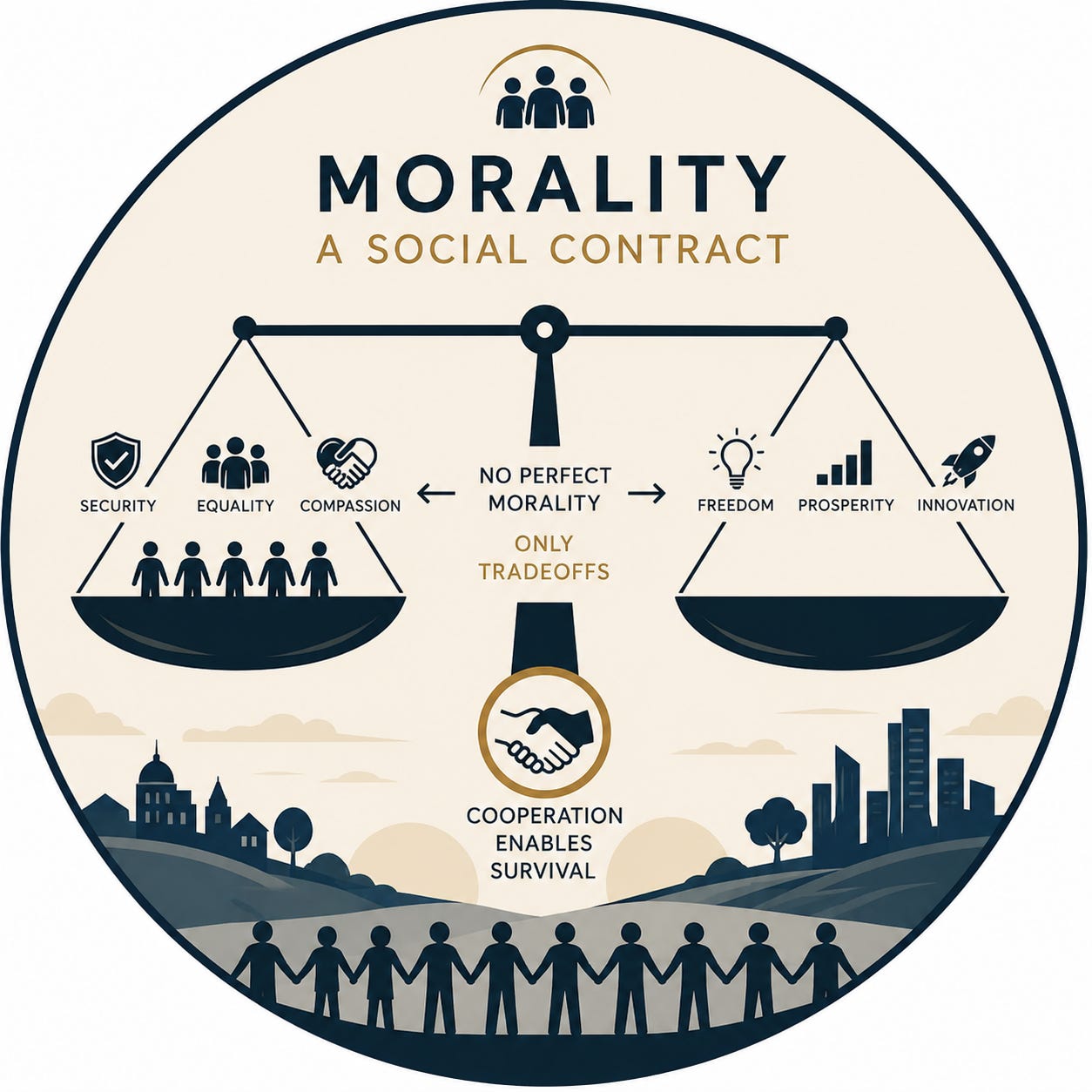
Morality is not a truth to discover. It is a contract to negotiate.
Most discussions about morality begin with a simple question:
What is right, and what is wrong?
For thousands of years, philosophers, religions, and political movements have offered competing answers. We often speak about morality as if there exists a correct set of moral truths waiting to be discovered, and humanity is slowly converging toward them.
But what if morality serves a different purpose?
What if morality is not primarily about discovering truth?
What if morality is primarily about helping groups survive?
Morality as a coordination technology
Imagine a society with no shared moral standards.
Every interaction would require negotiation from first principles.
Such a society would be extraordinarily expensive to operate.
Morality reduces these costs.
Norms such as honesty, reciprocity, loyalty, and fairness allow people to predict one another’s behavior without constantly recalculating every possible outcome. They create a common framework for cooperation.
In this sense, morality resembles a protocol more than a truth.
Just as traffic rules allow millions of drivers to coordinate without negotiating every intersection, moral norms allow millions of people to cooperate without renegotiating every social interaction.
Morality exists because constant negotiation is too expensive.
Why reasonable people disagree
One of the most uncomfortable facts about morality is that disagreement persists.
Not only between cultures.
Within them.
Consider abortion.
Millions of people view it as a fundamental component of bodily autonomy. Millions of others view it as the protection of human life.
Both groups often have access to the same information. Both contain thoughtful, educated, and sincere individuals. Yet they arrive at opposite conclusions.
The same pattern appears in debates over euthanasia, capital punishment, wealth redistribution, immigration, and free speech.
If morality were simply the discovery of objective facts, we might expect disagreement to gradually disappear as evidence accumulates.
Instead, many moral disagreements remain unresolved even when the facts are broadly understood.
Why?
Because moral disagreements are often not disagreements about facts.
They are disagreements about tradeoffs.
Two people can share the same facts, possess the same intelligence, act in good faith, and still reach opposite moral conclusions because they are optimizing different objective functions.
The hidden optimization problem
Freedom matters.
Equality matters.
Security matters.
Prosperity matters.
Fairness matters.
Innovation matters.
Stability matters.
The difficulty is that these values frequently conflict.
Increasing freedom may reduce stability.
Increasing equality may weaken incentives.
Increasing innovation may increase risk.
Improving efficiency may reduce resilience.
Moral debates are often framed as battles between right and wrong, good and evil, justice and injustice.
But underneath those labels often lies something more complicated.
A conflict between competing objectives.
Morality is often a multidimensional optimization problem disguised as a binary debate.
The challenge is not deciding whether values matter.
The challenge is deciding how much they matter relative to one another.
There is no perfect morality
Many people accept that moral systems differ.
But they still assume that somewhere, hidden among all possible moral systems, there must exist a perfect one.
The optimal morality.
The final answer.
The correct solution.
I am increasingly skeptical that such a thing exists.
Not because humans have failed to discover it.
But because the optimization problem itself may not have a perfect solution.
Every design improves some dimensions while accepting compromises in others.
Moral systems face the same challenge.
Some prioritize stability over innovation.
Some prioritize equality over incentives.
Some prioritize individual freedom over collective coordination.
Some prioritize future generations over present ones.
None eliminate tradeoffs.
They simply choose different ones.
Every moral system solves some problems by accepting others.
Survival is more complicated than it looks
If morality exists to help groups survive, then perhaps survival can serve as the ultimate evaluation criterion.
At first glance, this seems reasonable.
Groups survive or they do not.
Civilizations flourish or they collapse.
Simple.
Except history is not a controlled experiment.
Imagine two societies.
One values caution, stability, and risk avoidance.
The other values exploration, ambition, and experimentation.
A century later, one survives while the other disappears.
Did the surviving society possess the superior morality?
Not necessarily.
Perhaps it occupied better land.
Perhaps it avoided a drought.
Perhaps it encountered weaker rivals.
Perhaps it was simply lucky.
The outcome of a civilization reflects not only its choices, but also its environment.
A successful outcome does not necessarily imply a good strategy. A failed outcome does not necessarily imply a bad one.
This is the same reason investors do not evaluate decisions solely by outcomes. Someone can make a reckless bet and become rich. Someone else can make a prudent decision and lose money.
The result alone does not reveal the quality of the decision.
History suffers from the same problem.
Survival for whom?
Even if survival is the goal, another problem immediately appears.
Survival for whom?
The individual?
The family?
The tribe?
The nation?
Future generations?
Humanity itself?
A moral principle that benefits a group may impose costs on individuals.
A policy that helps the present generation may burden future ones.
A norm that increases short-term prosperity may reduce long-term resilience.
A society may become wealthier while becoming more fragile.
Different moral systems answer these questions differently.
There is no universally accepted objective function hidden underneath morality.
Many moral disagreements are not disagreements about reality. They are disagreements about what should be optimized and who should benefit from it.
The tyranny of time
Time introduces yet another tradeoff.
Some moral systems appear successful over decades but fail over centuries.
Others impose short-term costs while generating long-term advantages.
A society that prioritizes stability may prosper for generations before becoming stagnant.
A society that embraces experimentation may experience repeated crises before producing extraordinary innovation.
The answer depends not only on what happens.
It depends on when you choose to measure it.
Short-term and long-term optimization frequently point in different directions.
The problem of history
The deepest challenge is that we rarely get to test moral systems.
The Roman Empire happened once.
The Industrial Revolution happened once.
Every civilization receives a single attempt.
We observe outcomes, but we never observe alternatives.
What if a society had adopted different norms?
What if a civilization had made different tradeoffs?
What if a culture that disappeared might have flourished under slightly different circumstances?
We do not know.
History provides outcomes.
It does not provide control groups.
History gives us outcomes. It does not give us counterfactuals.
From moral philosophy to computational morality
For thousands of years, morality has remained largely within the domains of philosophy, religion, politics, and intuition.
We argue.
We speculate.
We inherit norms.
But we rarely get to experiment.
Artificial intelligence may begin to change that.
For the first time, we are creating large populations of agents capable of cooperation, competition, negotiation, reputation-building, punishment, reward, and collective decision-making.
Unlike human civilizations, these societies can be simulated repeatedly.
Different rules can be tested.
Different incentive structures can be explored.
Alternative social contracts can be compared.
This does not mean AI will tell us what is morally right.
But it may allow us to study morality in a fundamentally different way.
Not merely as philosophy.
But as an emergent property of interacting agents.
Not merely as a belief system.
But as a computational phenomenon.
For most of history, morality was inherited. For the first time, it may become experimentable.
The question ahead
The deeper I think about morality, the less it resembles a search for universal truth and the more it resembles a search for workable social contracts under uncertainty.
Humans do not possess perfect information.
We cannot predict the future.
We do not know which tradeoffs future generations will consider wise or foolish.
So societies do something practical.
They negotiate.
They adapt.
They coordinate.
They create imperfect agreements about how people should behave toward one another.
Some succeed.
Some fail.
Most live somewhere in between.
The question may no longer be:
“What is the right morality?”
Perhaps the more interesting question is:
What kinds of social contracts emerge, cooperate, adapt, and flourish under different worlds?